Europe Confidential
Mike Connoy and His Column
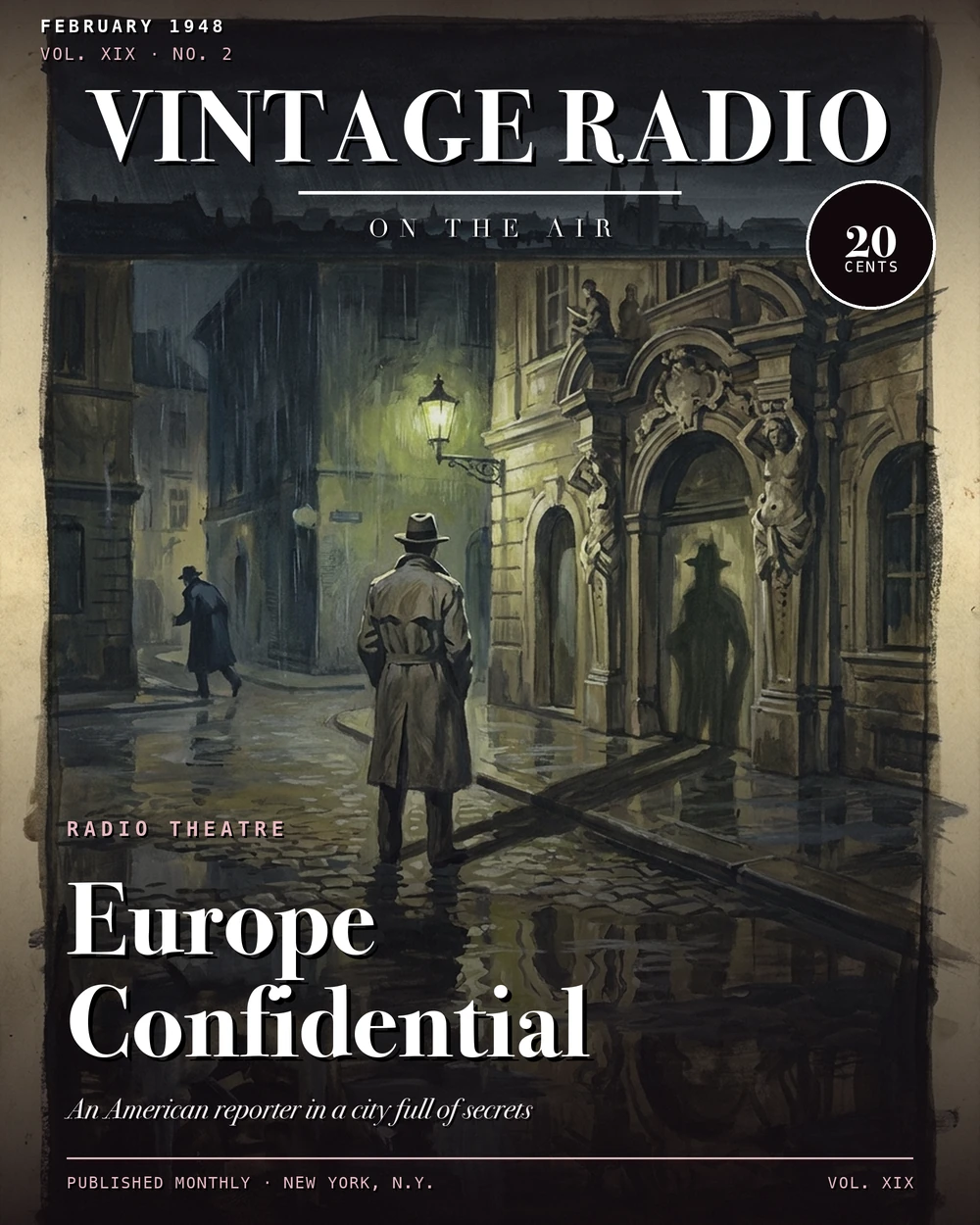
The premise of Europe Confidential is built into the title. Mike Connoy is an American newspaper reporter working out of Paris, and "Europe Confidential" is literally the name of his column — so every case he investigates doubles as a dispatch from the front lines of postwar intrigue. Connoy isn't a private eye or a cop. He's a foreign correspondent who keeps stumbling into espionage, murder, blackmail, art theft, and cases of mistaken identity in the unsettled, morally tangled Europe of the late 1950s. The framing device gives the show a documentary feel, as if these stories were things that actually happened and Connoy is simply setting the record straight.
Connoy was played by Lionel Murton, a London-born, Canadian-raised character actor who made a career out of playing North Americans convincingly in British productions. Born June 2, 1915, Murton brought an easy transatlantic credibility to the role. Connoy reads as an American to the ear but the production is unmistakably British in its sound and sensibility — which suited the show's international audience just fine.
The cases take Connoy across a wide range of European settings and situations. A missing Englishman in Tangier, a postwar serial killer loose in Berlin, a Paris scientist pitching investors on a supposed time machine — the episodes in the surviving run cover a lot of ground, both geographically and in tone. Some lean into straight crime-detective territory; others push further into espionage and Cold War tension. The episode titles reflect that range: Sniper Affair, Blackmailed Spy Affair, Museum Break-In Affair, Time Machine Affair, Circus Clown Affair. The word "Affair" in each title carries a hint of Continental sophistication, as if these aren't just crimes but incidents — things that happened, were handled, and will now be reported.
The Production Behind It
Europe Confidential was most likely produced by Harry Alan Towers through his London-based outfit commonly known as Towers of London. If that name rings a bell from radio history, it should — Towers was the same entrepreneur behind Orson Welles's The Lives of Harry Lime and The Black Museum, two of the more distinctive British-made syndicated radio series of the era. The Towers operation had a particular knack for producing slick, American-inflected drama in British studios and selling it internationally, and Europe Confidential fits that template closely. The resemblance between at least some of the Europe Confidential scripts and scripts from The Lives of Harry Lime — which ran in 1951 and 1952 — is noticeable enough to be more than coincidence, and consistent with the shared production lineage.
On the American distribution side, Frederick Ziv handled the syndication. Ziv was a major force in transcription-disc syndication during the radio era, placing shows with individual stations across the U.S. and internationally. The arrangement with Towers was a fairly typical one for the period: British production house makes the show, American syndicator presses the discs and moves them through the market.
That said, the show appears not to have found much traction in major American markets. A search of historical newspaper records from the New York Times, Washington Post, and Baltimore Sun turns up nothing for either Europe Confidential or its umbrella series The World's Greatest Mysteries. The show was playing, but primarily in Canada, Australia, and the UK. Radio listings in the Sydney Morning Herald, the Saskatoon Star-Phoenix, and the Glasgow Bulletin & Scots Pictorial all document airings in 1957 and 1958, confirming that international syndication was where the series actually landed.
Basil Rathbone and The World's Greatest Mysteries
The show existed within a larger syndication package called The World's Greatest Mysteries, hosted by film and radio star Sir Basil Rathbone. In some markets, radio listings identified it as WGM/Europe Confidential, reflecting the dual identity. Rathbone's introductions were recorded separately and edited onto each episode — he introduces the show and the central character of Mike Connoy, but doesn't narrate the specific story of the week. His role is essentially that of a prestige wrapper, lending the package the weight of his name and his distinctive voice.
Rathbone was a logical choice for this kind of hosting assignment. By 1957 he was one of the most recognizable voices in English-language entertainment, associated in the public mind with sharp intellect and Continental sophistication through his long run as Sherlock Holmes on screen and on radio. Using him to frame a mystery anthology series built around European intrigue made a certain kind of commercial sense — his presence signaled to programmers and audiences alike that this was a quality product, even before the first scene played.
The double-branding served a practical purpose too. Under the World's Greatest Mysteries umbrella, Towers and Ziv could package multiple programs together and sell them as a suite. Europe Confidential was the Mike Connoy installment of that broader offering.
What the Show Sounded Like
The production drew comparisons to other crime-detective radio programs of the period, including Adventures of Philip Marlowe and The Avenger. Like those shows, Europe Confidential combined sharp dialogue and tense plotting with characters who operated in morally ambiguous territory. Connoy isn't simply a good man chasing bad ones — the world he moves through is full of people who have compromised, collaborated, survived, and reinvented themselves in the wreckage of postwar Europe, and the stories take that complexity seriously.
The audio style leaned toward what might be called cinema-style radio — effects and atmosphere used to establish locale and mood rather than simply to fill space. A Paris street sounds like Paris, or at least like a plausible radio approximation of it. A Berlin back room feels appropriately shadowy. The show was produced with a level of craft consistent with Towers's other work of the period, where the physical sound of each scene was part of the storytelling.
Episodes were self-contained, each one a complete case, but the cumulative effect of the series is of a particular world — Cold War Europe as seen through the eyes of an American reporter who is skeptical by profession, unflappable by temperament, and deeply familiar with how things actually work in cities still reorganizing themselves after a catastrophic war.
The Run and What Survives
The show aired in 1957 and 1958. In Saskatoon, it ran on CFCQ at 9:30 Monday nights before shifting to 7:30; by May 1958, its time slot had been handed over to Radio Novels, which is about as clear an end-of-run signal as a radio listing can give. The overall international run was likely similar — a year or so of syndication, after which the transcription discs moved out of active rotation.
Twenty-two episodes survive in the current catalog. The run includes Air Race Affair, Fountain Affair, Museum Break-In Affair, Raymond Shortly Affair, Brett Monahan Affair, Circus Clown Affair, Football Pool Affair, Sniper Affair, Time Machine Affair, Desert Gold Affair, Paul Winfield Affair, and Blackmailed Spy Affair, among others. That's a substantial portion of what was apparently a modestly sized series to begin with, and it gives a reasonably full picture of what Connoy's world looked and sounded like across the run.
The show never made a splash in American newspaper radio columns and never became a major cultural reference point the way some of its contemporaries did. What it was, more precisely, was a competently made, internationally distributed crime-detective series that reflected something real about its moment — the anxiety and moral ambiguity of postwar Europe, filtered through the sensibility of a British production company with a talent for making shows that sounded American enough to travel.